
Best AI Novel Generators in 2026: An Honest Comparison
Compare the best AI novel generators of 2026 for continuity, editing, cover art, audiobook creation, exports, speed, and transparent pricing for authors.
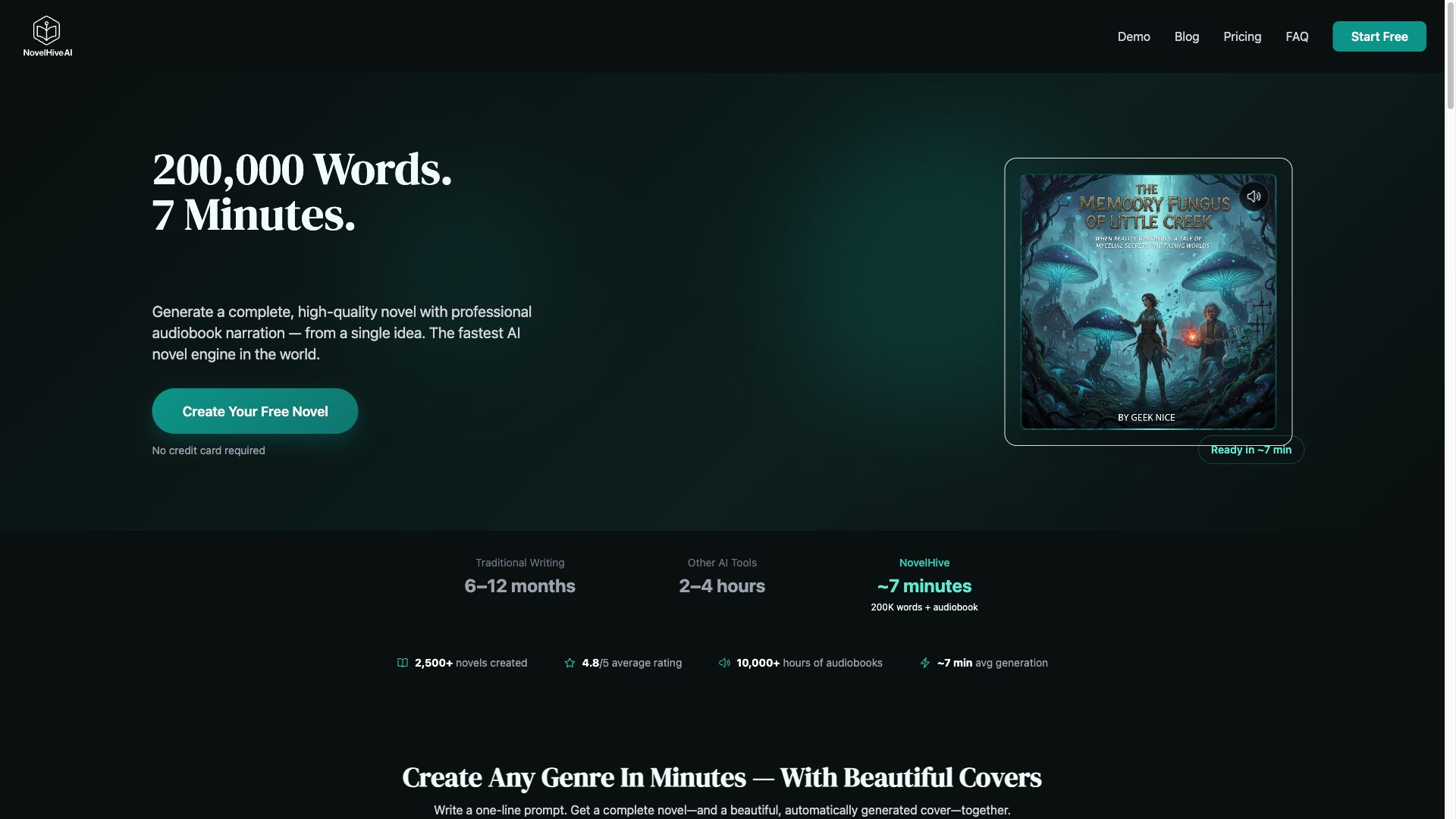
AI writing products now span fiction-focused editors, author-controlled workspaces, conversational assistants, and end-to-end generation systems. The right choice depends on whether you need drafting control, story organization, manuscript-to-audiobook production, or a combination.
Features, plan limits, and model access change often. This comparison focuses on durable workflow differences and links to each vendor's official site so you can verify current capabilities, pricing, and commercial terms before choosing.
We reviewed the publicly documented workflows of seven products. Use this as a decision framework, then test your own material and confirm plan-specific limits, exports, model access, and rights with each provider.
What Makes a Great AI Novel Generator?
Before diving into specific platforms, here are the criteria that actually matter:
- Story Continuity: What story bible, lore, file, or project-context tools help carry decisions across chapters?
- Generation Quality: Does the prose sound human-written, or like a corporate memo with fantasy nouns?
- End-to-End Pipeline: Can you go from idea to finished manuscript without juggling five different tools?
- Speed: How long does text generation take, and does the product report separate cover and audio stages clearly?
- Integrated Outputs: Does the current workflow cover only writing, or also cover art, audio narration, and the export formats you need?
- Honest Pricing: Can you predict what a novel will cost before you start?

The Contenders: 7 AI Novel Generators Compared
These seven products represent different workflow categories, from fiction-focused tools to general-purpose AI workspaces. The comparison below describes those categories rather than declaring a universal winner.
1. NovelHive AI -- Audiobook-First Workflow
What it is: An audiobook-first platform that converts uploaded manuscripts into multi-voice audiobooks and can also generate a novel, cover, and audio from one idea.
What impressed us: NovelHive combines manuscript import, character extraction, voice casting, narration, synchronized reading, editing, cover tools, and audiobook export in one workflow. Its separate idea-to-book pipeline uses specialized models for planning and prose.
NovelHive generates the text first, then runs optional cover and audiobook work as separate stages. Total processing time varies with requested length, queue conditions, retries, and external provider response.
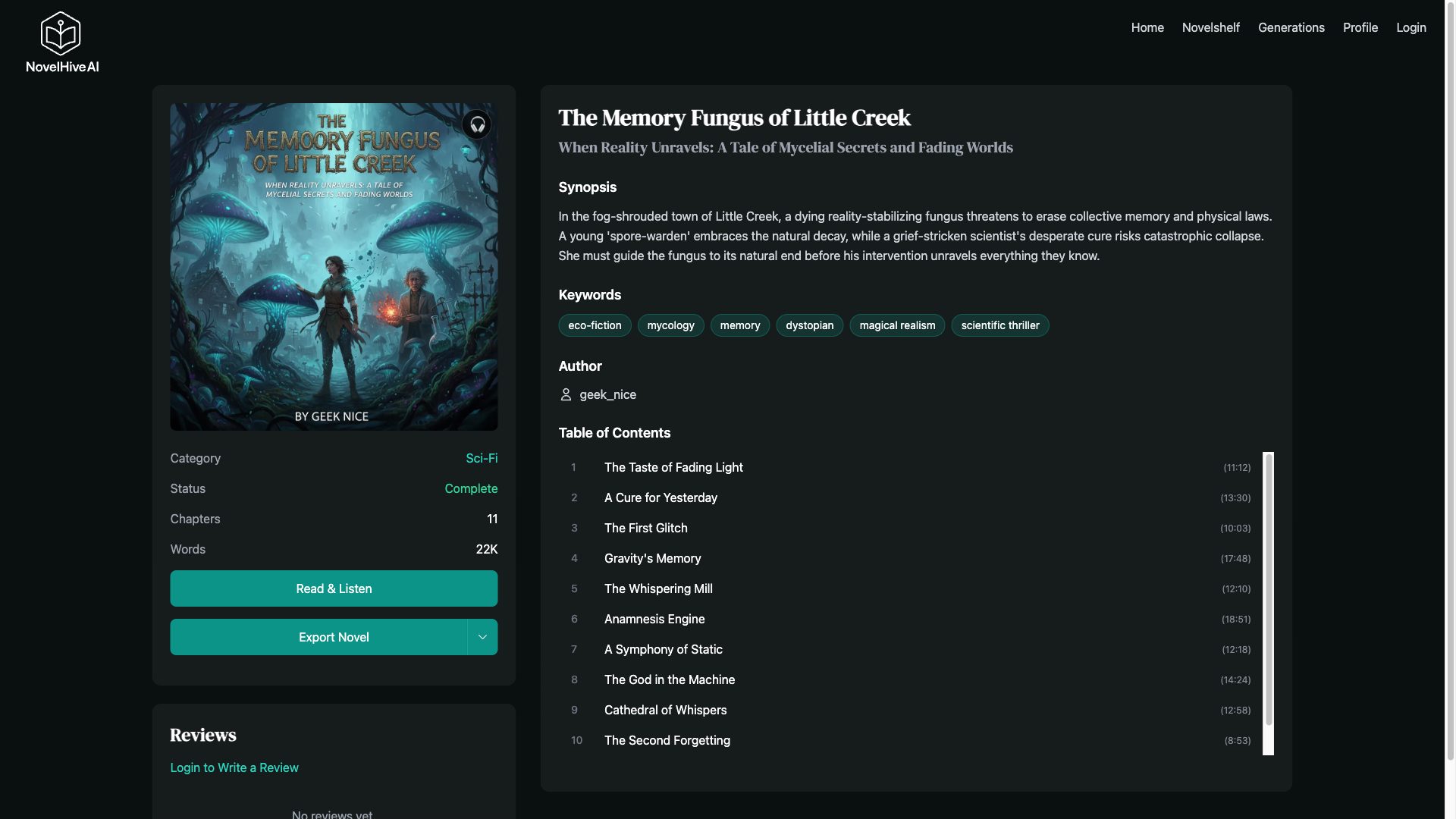
NovelHive separates its outputs so authors can choose which stages to run:
- Optional AI-generated cover art informed by the novel's metadata
- Optional multi-voice narration with chapter-by-chapter playback
- Chaptered text produced from shared book specifications, plot planning, and scene context
- Chapter-by-chapter organization with instant navigation
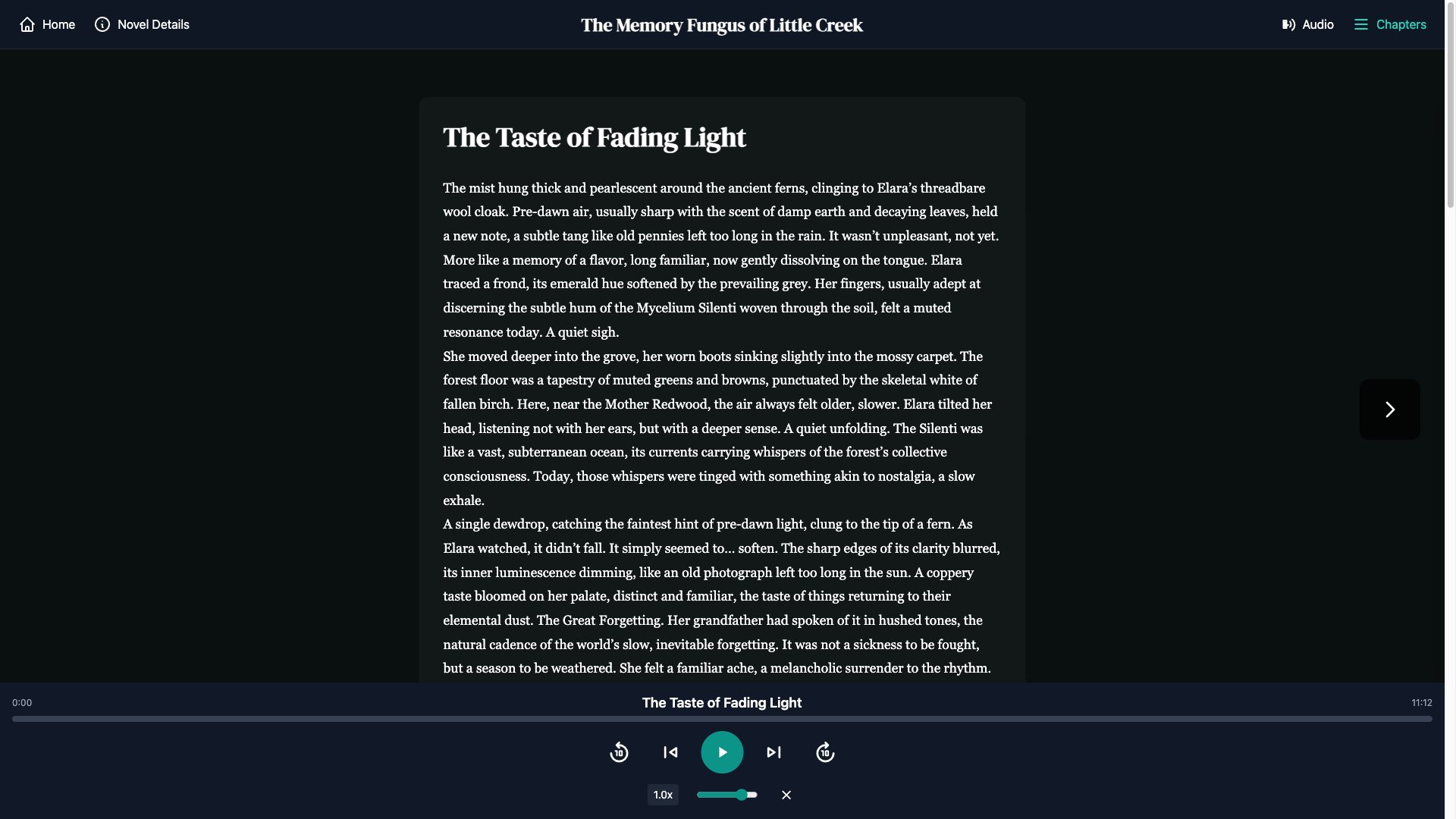
Pricing: NovelHive uses pay-as-you-go credits. Text, optional cover work, editing, and optional audio are priced separately; the product shows an estimate before paid work starts. Purchased credits do not expire under the current Terms.
Best for: Writers who want an integrated manuscript-to-audiobook workflow, or an idea-to-novel workflow with optional cover and audio stages.
Honest limitations: NovelHive is designed for full automated generation rather than collaborative writing. If you want to write alongside the AI, adjusting every paragraph as you go, a more interactive tool like Sudowrite or NovelCrafter might be a better fit.
2. Sudowrite -- Fiction-Focused Writing Assistant
What it is: A fiction-focused writing assistant with guided drafting, revision tools, Story Bible, and Story Engine features described on Sudowrite's official site.
Workflow strength: Fiction-specific tools organize story context and support guided drafting and revision. Prose preference is subjective, so evaluate it with scenes from your own project.
Workflow tradeoff: Sudowrite centers on writing and revision rather than NovelHive's integrated manuscript-to-multi-voice-audiobook pipeline. Verify current image, audio, export, and plan capabilities on its official site.
Pricing: Sudowrite uses subscription plans. Check its official pricing page for current tiers, limits, and included features.
Best for: Fiction writers who want guided drafting and revision controls inside a dedicated writing environment.
Consider: It is an author-in-the-loop writing workflow. The amount of drafting and editing time depends on your process, manuscript, and quality bar.
3. NovelCrafter -- Author-Controlled Writing Workspace
What it is: An author-controlled writing workspace that can connect to supported external model providers, with a Codex for story information.
Workflow strength: Its Codex and planning tools organize characters, locations, lore, and relationships while the author controls model choice and generation steps.
Workflow tradeoff: It emphasizes configurable, author-directed writing. Connected model setup, provider billing, and the path to cover or audiobook assets remain choices the author must verify and manage.
Pricing: Platform plans and any connected model-provider costs are separate. Check the official pricing and provider documentation for current terms.
Best for: Authors who value detailed project organization and direct control over model providers and generation steps.
Consider: A configurable workflow can require more setup and provider management than a bundled service. The time required depends on how much control you keep.
4. Squibler -- Book-Writing Workspace
What it is: An AI book and novel writer with visual plotting tools and full manuscript generation.
Workflow strength: Squibler presents AI-assisted writing alongside planning tools. Check the official product pages for current trial limits, image features, and exports.
Workflow tradeoff: Generated prose and long-form continuity depend on the manuscript, instructions, and current model configuration. Test the workflow against your own quality criteria.
Pricing: Free and paid offerings may be available. Verify current limits, renewal terms, and included features on Squibler's official site.
Best for: Writers on a budget who want to experiment before committing.
Consider: As with every AI writing product, review and edit the output before publication; no plan or model guarantees publication-ready prose.
5. NovelistAI -- Multi-Format Story Generator
What it is: An AI-powered multi-format story generator that creates novels, gamebooks, poetry, screenplays, and more.
Workflow strength: NovelistAI markets multiple story formats and media features. Confirm current language, image, audiobook, and export coverage on its official site.
Workflow tradeoff: Multi-format breadth does not by itself establish prose quality or long-form continuity. Evaluate current editing controls and output with your own material.
Pricing: Credit and subscription offerings can change. Check the official pricing page for current allowances and media-generation costs.
Best for: Authors exploring multiple story formats who are willing to verify current language and media support for their project.
Consider: Review the generated structure and prose carefully; format breadth and writing quality are separate evaluation criteria.
6. NovelAI -- Interactive Storytelling Platform
What it is: An interactive AI storytelling and image-generation platform with Lorebook context and vendor-managed models.
Workflow strength: Interactive story continuation, Lorebook context, and image generation support an author-led creative process.
Workflow tradeoff: The experience is centered on iterative storytelling and image creation rather than a bundled manuscript-to-M4B production pipeline. Verify current models, context limits, image styles, and media features directly.
Pricing: NovelAI uses subscription plans. Check its official site for current tiers, model access, and limits.
Best for: Authors and world-builders who prefer interactive story continuation and image generation in the same creative workspace.
Consider: Model offerings and context limits change. Evaluate current output quality and the amount of author guidance your workflow requires.
7. ChatGPT / Claude -- General-Purpose AI Workspaces
What they are: General-purpose AI workspaces used for brainstorming, research, drafting, file-based projects, and revision. Their tools and plan limits change frequently.
Workflow strength: Project files, long-context conversations, and editing tools can support long-form work when the author actively manages context and structure. Continuity depends on the model, plan, supplied files, and workflow rather than a fixed page threshold.
Workflow tradeoff: These products offer more than a basic chat window, but they are not the same as a dedicated fiction database or an integrated multi-voice audiobook export pipeline. ChatGPT includes project, Canvas, export, and image tools; verify each vendor's current feature documentation.
Pricing: Both vendors offer multiple plans whose features and limits change. Confirm current terms on their official pricing pages.
Best for: Flexible brainstorming, research, drafting, and revision when you are comfortable managing the broader book-production workflow yourself.

How NovelHive Combines the Workflow
NovelHive supports two distinct workflows: upload a finished manuscript and turn it into an audiobook, or start from one idea and create the novel, cover, and audio together.
A True 7-Stage Automated Pipeline
NovelHive's idea-to-novel workflow runs seven distinct stages and routes planning, scene design, prose, and finalization through specialized configured models:
- Book Specification -- defines genre, themes, characters, and world
- Metadata Generation -- creates synopsis, keywords, and marketing copy
- Plot Architecture -- builds a multi-act story structure
- Plot Enhancement -- deepens subplots and character arcs
- Scene Breakdown -- maps every chapter's scenes in detail
- Content Generation -- writes every chapter with full scene context
- Finalization -- assembles the novel, generates cover art and audio
NovelHive's differentiator is the specific connection between staged story generation, optional cover work, optional multi-voice narration, synchronized reading, and export. Other products use different levels of author control and automation, so compare the workflow rather than assuming a feature is absent.
Built-In Cover Art Generation
NovelHive offers optional AI-generated cover art informed by the novel's genre, tone, and setting. Cover generation is a separate credit-based stage and authors should review typography, rights, and market fit before publishing.
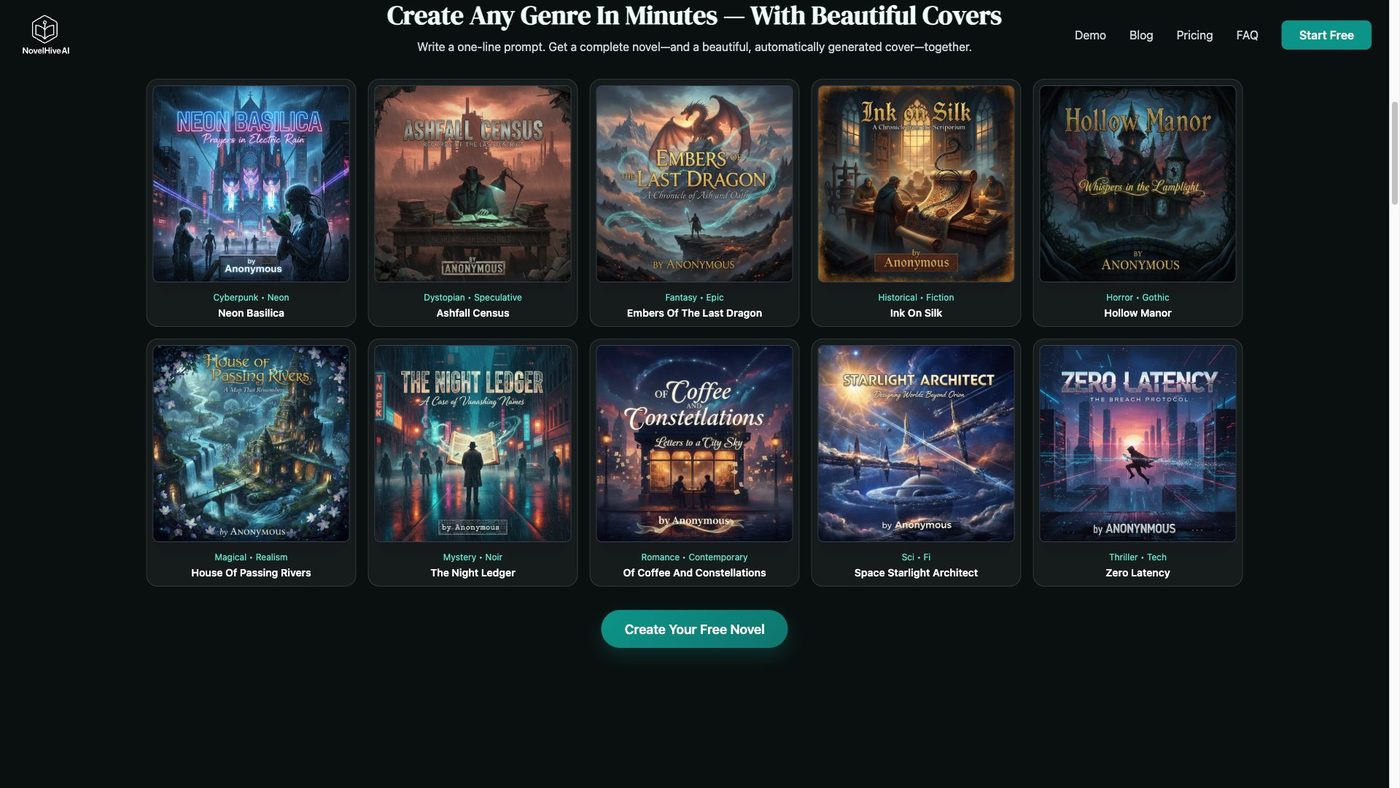
Image and cover capabilities vary by product and plan. ChatGPT, for example, includes native image-generation tools. NovelHive's distinction is that optional cover generation is tied to the same novel project and its metadata; verify every vendor's current export and commercial-use terms.
Squibler and NovelistAI do offer cover art, but NovelHive's covers are generated as part of the pipeline with context about your specific novel -- genre, tone, and setting inform the image.
Audiobook-First Multi-Voice Narration
NovelHive can generate chapter-by-chapter audio with narrator and character voices, synchronized reading, progress tracking, and M4B or MP3 export. Audio is optional and priced separately from text generation.
Audiobook capabilities change quickly across competing products. Verify each vendor’s current voice, export, rights, and pricing terms directly; this guide focuses on NovelHive’s integrated manuscript-to-audio workflow.
Generation Time Varies by Scope
NovelHive runs planning, scene design, prose, and metadata as the text-generation pipeline. Optional cover and audiobook work starts in separate stages; timing for each depends on requested length, queue conditions, retries, and external provider response.
Compare this to the alternatives:
- Sudowrite: guided fiction drafting and revision inside its writing workspace
- NovelCrafter: author-controlled generation with connected model providers
- ChatGPT/Claude: project-based conversational drafting, file context, and editing tools
- NovelAI: interactive story continuation guided by the author
Pay-As-You-Go, Without a Required Subscription
This is the pricing difference that matters most:
| Product | Pricing approach | What to verify |
|---|---|---|
| NovelHive | Pay-as-you-go credits | Text, editing, cover, and audio estimates before paid work; purchased credits do not expire under current Terms |
| Sudowrite | Subscription plans | Current plan limits and included features on the official pricing page |
| NovelCrafter | Platform plan plus connected provider costs | Workspace limits and separate model-provider billing |
| Squibler | Free and paid offerings may be available | Current AI limits, exports, and renewal terms |
| NovelistAI | Credit or subscription offerings may change | Current allowances and image or audio generation costs |
| NovelAI | Subscription plans | Current tier limits and model access |
NovelHive uses pay-as-you-go credits rather than a required subscription. Cost varies by novel length, editing, cover, and audio; the product shows an estimate before paid work starts.
Full Feature Comparison
Here is how every platform stacks up across the features that matter:
| Feature | NovelHive | Sudowrite | NovelCrafter | Squibler | NovelistAI | NovelAI | ChatGPT/Claude |
|---|---|---|---|---|---|---|---|
| Long-form workflow | Idea-to-novel pipeline; manuscript upload | Story Engine and guided drafting | Author-driven with connected models | AI-assisted book workflow | Multi-format generation workflow | Interactive story continuation | Project-based conversational drafting |
| Workflow style | Staged text pipeline; optional cover and audio | Fiction writing assistant | Configurable writing workspace | Writing and planning workspace | Story generation workspace | Interactive storytelling | General-purpose AI workspace |
| Image / cover workflow | Optional cover stage in the novel project | Verify current product capabilities | Use connected tools or workflow | Verify current product capabilities | Verify current product capabilities | Image generation available | ChatGPT image tools; Claude features vary |
| Audiobook workflow | Optional multi-voice narration; M4B or MP3 export | Verify current product capabilities | Verify current product capabilities | Verify current product capabilities | Verify current product capabilities | Verify current product capabilities | Voice features are not the same as audiobook export |
| Model approach | Specialized provider routing by stage | Vendor-managed fiction models | Author-selected connected providers | Vendor-managed models | Vendor-managed models | Vendor-managed models | Vendor models and tools |
| Continuity tools | Book specification, plot, and scene context | Story Bible | Codex | Planning and project tools | Project and story context | Lorebook | Projects, files, and conversation context |
| Processing time | Varies by length, queue, retries, and provider | Varies by task and plan | Varies by model and author workflow | Varies by task and plan | Varies by task and plan | Varies by task and plan | Varies by model, plan, and workflow |
| Pricing model | Pay-as-you-go credits | Subscription; verify current plans | Platform plus provider costs | Verify current official plans | Verify current official plans | Subscription; verify current plans | Multiple plans; verify current terms |
| Entry option | Free account and manuscript upload; generation is paid | Verify current official offer | Verify current official offer | Verify current official offer | Verify current official offer | Verify current official offer | Verify each vendor's current offer |
Who Should Choose What
There is no single "best" AI novel generator -- it depends on what you need:
Choose NovelHive if you want to upload a manuscript and create a multi-voice audiobook in the same product, or if you want the secondary one-idea-to-novel-and-audio workflow. Credits are pay-as-you-go rather than a required subscription.
Choose Sudowrite if you want fiction-specific drafting and revision tools. Test its output with your own scenes and confirm current plans and limits on the official site.
Choose NovelCrafter if you want detailed story organization and control over connected model providers. Account for both workspace setup and external provider billing.
Choose Squibler if its planning and AI book-writing workflow fits your process; verify the current entry offer, limits, and exports directly.
Choose NovelistAI if you want to explore multiple story formats; confirm current language and media support for the exact format you need.
Choose NovelAI if creative freedom and minimal content restrictions matter most, especially for fan fiction.
Choose ChatGPT or Claude if you prefer a flexible general-purpose workspace and are prepared to manage story structure, asset creation, and audiobook production across your own workflow.
The Bottom Line
AI products now support many parts of book creation, but no tool removes the need to evaluate continuity, prose, rights, cost, and export quality. Test the workflow with your own manuscript before committing to a plan or production path.
Most platforms specialize in one part of the process. NovelHive differentiates through an audiobook-first workflow that connects manuscript import, editing, character casting, synchronized listening, and export.
Ready to compare the workflow yourself? Upload a manuscript to NovelHive, or start from an idea if you do not have a finished book.
Originally researched in February 2026 and revised on September 1, 2026. Product capabilities, model access, pricing, and commercial terms can change; verify them on each provider's official site.
Official product references reviewed September 1, 2026: NovelHive, Sudowrite, NovelCrafter, Squibler, NovelistAI, NovelAI, ChatGPT Projects, Claude.

NovelHive AI Team
Practical audiobook creation, narration, editing, and publishing guidance