
AI Novel Editing Is Here: Meet Author Agent
Prepare a manuscript for narration with Author Agent. Give one editorial note, review tracked changes, then create a cleaner multi-voice audiobook in NovelHive.

Key Takeaways
- Author Agent is NovelHive's AI editing feature for generated or uploaded novels. It can use full-novel context, accepts a plain-language editorial note, and proposes changes to the chapters relevant to that request.
- Proposed text changes appear as a tracked diff — red for removals and green for additions — so you can review them before applying them to the novel's draft.
- Author Agent uses pay-as-you-go credits. Cost varies with the request, context, model work, and provider usage; it should not be represented as a fixed per-edit price.
- Author Agent is designed to follow your editorial direction and existing prose, but AI edits can still alter voice. Review the complete diff and keep only the changes that fit your manuscript.
- Accepted edits go to a draft layer before publication. The session provides undo for supported checkpointed changes, and publishing remains a separate author action.
Finishing a draft does not finish the editorial work. A manuscript may still need tighter pacing, clearer character voice, or more focused dialogue. Authors can work with a human editor, revise manually, use software-assisted editing, or combine those approaches. Author Agent offers a reviewable AI-assisted option inside the same novel project.
The Editing Problem Nobody Talks About
Editing is iterative. Developmental structure, scene-level revision, line editing, copy editing, and proofreading solve different problems, and a serious manuscript may need more than one pass.
Professional editing quotes vary with manuscript length, service level, editor experience, schedule, and revision scope. AI-assisted editing is not equivalent to a human developmental edit, but it can help authors explore revisions before deciding where human expertise is most valuable.

AI editing tools range from sentence-level suggestions to project-based assistants with files and long context. The practical trust question is not whether a category can edit prose, but whether the author can see the proposed changes, control scope, and reject output that weakens the story.
Author Agent focuses on that review loop: give editorial direction, inspect the proposed diff, apply selected changes to draft, and publish only when the manuscript is ready.
Introducing Author Agent
Author Agent provides reviewable AI-assisted edits under the author's control.
Author Agent is a project-aware editing feature built into NovelHive novels. It accepts editorial direction in plain language, uses manuscript context, and proposes text changes as a tracked diff. The author still needs to assess continuity, voice, factual details, and whether each revision improves the book.
The feature can use full-manuscript context while working inside the project. Processing time depends on requested scope, queue conditions, retries, and provider response. Proposed text edits are presented for review rather than treated as automatically correct.
Author Agent is available from supported generated and uploaded novels in your NovelHive library. Open the editing workspace from the novel and provide an instruction for the section or issue you want to address.
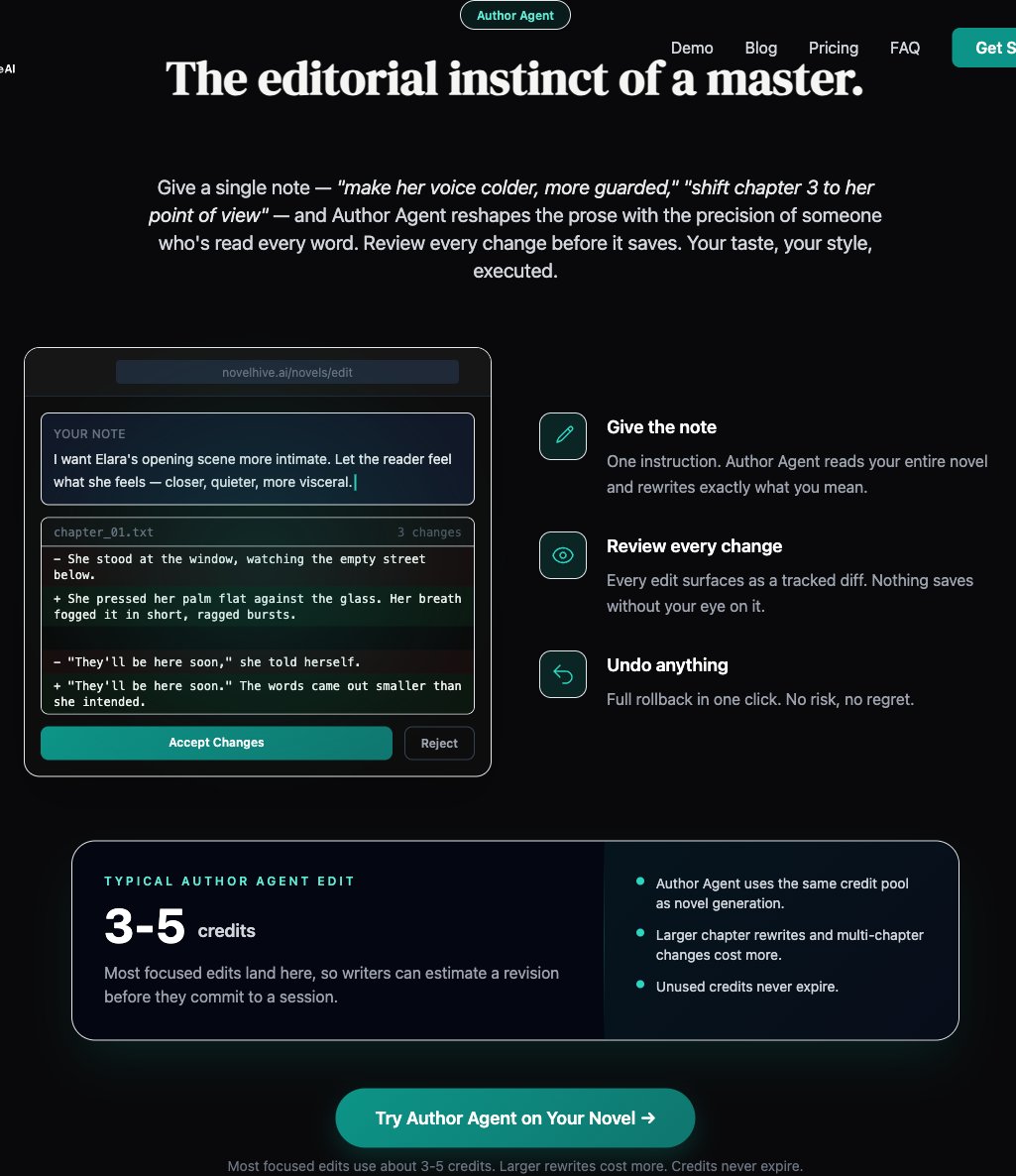
How It Works: Three Steps
Step 1: Give the Note
You talk to Author Agent the way you would talk to a human editor. No special syntax, no prompt engineering, no technical jargon. Just say what you want.
Some examples of real editorial notes:
- "Make Elara's opening scene more intimate — closer, quieter, more visceral."
- "The pacing in Act 2 drags. Tighten the prose and cut the filler."
- "Elena feels too passive in chapters 8 through 14. Give her more agency in her dialogue and internal monologue."
- "Shift chapter 3 from third person to first person."
- "The villain's motivation is unclear. Add subtle foreshadowing in the early chapters."
Author Agent uses the relevant chapters or full manuscript context according to the request, then proposes edits for review. Broad instructions may affect more chapters and require a more careful continuity pass by the author.
Step 2: Review Every Change
The central workflow is explicit review: proposed text appears as a diff before it is applied to the novel draft.
After processing, the tracked-changes view shows removed text in red and added text in green. It shows what changed; the author still decides whether the change serves the instruction and the larger manuscript.
Here is an illustrative Author Agent-style edit:
- She stood at the window, watching the empty street below.
+ She pressed her palm flat against the glass. Her breath fogged it in short, ragged bursts.

- "They'll be here soon," she told herself.
+ "They'll be here soon." The words came out smaller than she intended.

- The room was quiet except for the clock on the wall.
+ Somewhere behind her, the clock measured out seconds she couldn't afford to waste.
The original lines are competent. The edited lines have texture, physicality, and interiority. The character is no longer observing a scene — she is inside it, feeling it. That is the difference between a rough draft and a polished manuscript.
Review the complete proposal, keep the changes that work, and reject the ones that do not. Accepted changes are staged in the draft layer before a separate publish action updates the public version.
Step 3: Accept, Reject, or Undo
Once you have reviewed the diff, you have full control:
- Accept the edit to apply it to your novel
- Reject the edit to discard it entirely — your original text stays untouched
- Use undo for the latest supported checkpointed change when you need to restore the earlier draft state
Proposals can be rejected, and accepted edits are staged as drafts. Undo support is checkpoint-based, so confirm the current draft and export a backup before major or repeated revisions.
What Makes Author Agent Different
Editing tools use different context, review, and pricing models. The comparison below describes workflow differences; product features and plans change, so verify them on each provider's official site.
| Capability | Grammarly | ChatGPT / Claude | Human Editor | Author Agent |
|---|---|---|---|---|
| Context approach | Document and product context; verify current plan | Projects, files, and long context managed by the user | Manuscript review and author dialogue | Novel project context selected for the request |
| Narrative editing | Writing assistance varies by feature | General-purpose instruction following | Professional editorial judgment | Instruction-guided manuscript proposals |
| Review interface | Suggestions and revisions vary by feature | Canvas, artifacts, or chat revision tools vary | Commonly delivered with comments or markup | Tracked red/green diff before draft application |
| Pricing approach | Subscription or plan; verify current terms | Multiple plans; verify current terms | Project quote based on scope | Usage-based NovelHive credits |
| Timing | Varies by document and feature | Varies by task, model, and plan | Varies by editor and schedule | Varies by scope, queue, retries, and provider |
| Voice preservation | Requires author review | Requires author review | Depends on editor-author fit | Design goal; requires author review |
| Change control | Suggestion controls vary by feature | Interface-dependent | Often available through markup workflow | Explicit proposal review and draft workflow |
Grammarly provides writing suggestions and document-level assistance whose available features depend on the current product and plan. Compare its revision controls and context handling with the kind of story-level edit you need.
ChatGPT and Claude provide project files, long-context conversations, and editing tools. Long-form continuity depends on the model, plan, supplied context, and how the author structures the workflow; there is no fixed page threshold that applies to every project.
A human developmental editor can bring judgment, dialogue with the author, genre experience, and accountability that software does not replicate. Quotes and schedules vary by manuscript, editor, service level, and revision scope.
Author Agent combines manuscript context with a tracked review workflow and usage-based credits. It can complement self-editing or a human editor, but it should not be presented as equivalent to professional developmental judgment.

Illustrative Edits: Before and After
The examples below illustrate the kind of direction an author might request and the type of revision they would then need to review.
Example 1: Making a Character Voice More Distinctive
The note: "Kael sounds too generic. He's a former soldier — make his dialogue clipped, direct, uncomfortable with emotion."
Before:
"I think we should probably consider leaving before they find us," Kael said, looking around nervously. "I don't want anyone to get hurt because of my mistakes. I've made too many of those already."
After:
"We move. Now." Kael checked the door frame without turning his back to the window. "My fault they're close. Won't be my fault if they're closer."
The character went from a generic dialogue placeholder to someone with a distinct cadence — short sentences, no wasted words, deflecting emotion through action. That is voice.
Example 2: Tightening Prose and Cutting Filler
The note: "Chapter 7 is bloated. Cut the filler and make every sentence earn its place."
Before:
The morning sun cast a warm golden glow over the small village as Sarah made her way down the narrow cobblestone street. She could hear the sounds of merchants setting up their stalls and the smell of fresh bread wafted through the air. It was a beautiful morning, the kind that made you feel like anything was possible.
After:
Golden light slanted across the cobblestones. Merchants wrestled with awning poles and the smell of fresh bread cut through the cold. Sarah walked fast. Mornings like this were for people with nothing to outrun.
The original is 68 words of pleasant scene-setting. The edit is 37 words that establish the same scene while revealing character. The village is the same; the protagonist is sharper.
Usage-Based Editing
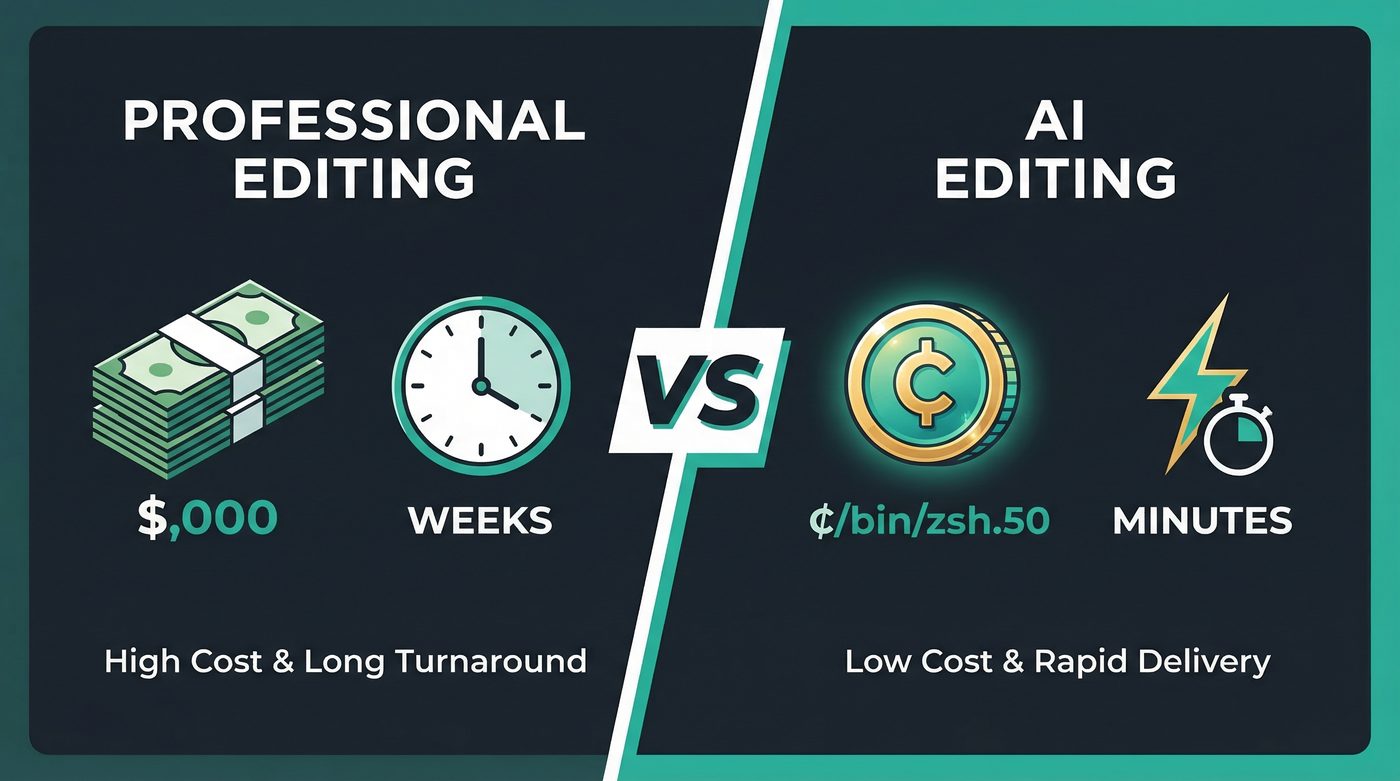
Author Agent uses the NovelHive credit system. The final cost varies with edit scope, manuscript context, model work, and provider usage; do not assume a fixed cost from an earlier example.
Compare the pricing approach and review workflow:
- Human developmental editor: project quote based on manuscript length, service level, schedule, and revision scope
- Writing software subscription: verify the current plan, limits, and renewal terms on the provider's official site
- Freelance line editor: project quote based on word count, depth, schedule, and editor experience
Author Agent does not require a subscription; usage is charged in credits when model work runs. Purchased credits do not expire under the current Terms, while promotional or free credits may have different conditions. Cost is not a substitute for comparing the scope and judgment of different editing options.
Author Agent is not a claim that AI replaces a human editor. It is an on-demand way to explore and review revisions inside the manuscript project. Authors can use it for an early pass, combine it with manual revision, or take a clearer draft to a human professional.
Frequently Asked Questions
What is Author Agent?
Author Agent is NovelHive's built-in AI editing feature for supported generated and uploaded novels. It accepts an editorial note, uses manuscript context, and proposes changes to relevant sections. Text changes appear as a tracked diff for review before they are applied to the draft.
How much does an Author Agent edit cost?
Cost varies with the instruction, manuscript context, model work, and provider usage. Author Agent does not require a subscription. Purchased credits do not expire under the current Terms; promotional or free credits may have different conditions.
Can Author Agent edit any novel on NovelHive?
Author Agent is available for supported novels in your library, including generated novels and uploaded manuscripts. It can use full-text context, but edit quality still depends on the source material, instruction, model behavior, and the author's review.
Will Author Agent change my writing voice?
Author Agent is designed to follow the manuscript and your instruction, but no AI can guarantee voice preservation. Review the entire diff for rhythm, vocabulary, characterization, and continuity before accepting a change.
Can I undo Author Agent edits?
Proposed edits can be rejected, and accepted edits are staged in a draft layer before publication. Undo is available for supported checkpointed changes; confirm the draft and keep an export before extensive revision work.
Start Editing Smarter
Author Agent is live on NovelHive right now. If you have a generated or uploaded novel, give an editorial note and review the resulting diff after processing. Timing varies with edit scope, queue conditions, retries, and provider response.
No subscription is required. Give a plain-language instruction, review the proposed changes, and keep only what works for the manuscript.
Moving from draft to publication requires judgment and revision. Author Agent offers an on-demand editing pass whose processing time depends on scope, queue conditions, retries, and provider response. Treat every proposal as material to review, not as a guaranteed improvement.
Try Author Agent on your next novel at novelhive.ai
Official references reviewed September 2, 2026: NovelHive, NovelHive Terms, Grammarly, ChatGPT Projects, Claude, Editorial Freelancers Association rates. Product capabilities, pricing, and editorial quotes can change.
Related reading: How AI Writes a Novel | Inside the 7-Stage Pipeline | Best AI Novel Generators Compared

NovelHive AI Team
Practical audiobook creation, narration, editing, and publishing guidance